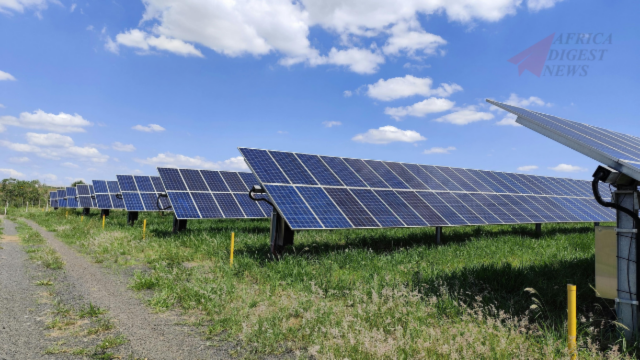
Egypt has secured major financing from European and international development banks for the Obelisk solar and battery storage project in Qena Governorate, advancing what is set to become Africa’s largest hybrid solar photovoltaic facility.
In January 2026, the European Investment Bank (EIB), through EIB Global, committed USD 150 million to the project as the first phase of the plant was inaugurated in southern Egypt.
The facility is being developed by Norwegian renewable energy company Scatec ASA. Once completed, it will deliver up to 1.1 gigawatts (GW) of solar capacity alongside a 100-megawatt / 200-megawatt-hour battery energy storage system.
The hybrid configuration is designed to supply electricity beyond daylight hours and support grid stability during periods of peak demand.
The EIB’s USD 150 million commitment adds to earlier funding from a group of development finance institutions, including the European Bank for Reconstruction and Development (EBRD), the African Development Bank (AfDB), and British International Investment (BII).
Together, the institutions have provided approximately USD 479 million, covering nearly 80% of the project’s estimated USD 590 million total cost.
The EBRD supported the project with equity bridge financing and long-term loans during construction. The AfDB contributed additional financing aimed at strengthening the project’s long-term sustainability.
The lenders coordinated under the “Team Europe” framework, which pools capital, shares risk, and provides technical support for strategic infrastructure projects in partner countries.
Obelisk forms part of Egypt’s plan to increase renewable energy to 42% of total electricity generation by 2030.
Read Also: Local Capital Is Moving, but African Energy Risk Has Not Disappeared
Large-scale solar projects paired with battery storage are intended to reduce reliance on gas-fired generation and address intermittency by providing dispatchable power.
Once fully operational, the plant is expected to supply electricity to millions of households and improve reliability across the national grid. The battery system will allow stored solar energy to be released during evening demand peaks.
Egyptian authorities say construction and operations will create jobs and support local economic activity in Upper Egypt, while building technical expertise in renewable and storage technologies.
Prime Minister Mostafa Madbouly attended the inauguration of the project’s first phase, signaling government support for accelerating clean energy deployment.
With financing secured and initial operations underway, Obelisk is among the largest solar-plus-storage developments currently under construction in Africa and represents a significant addition to Egypt’s utility-scale renewable capacity.
By Thuita Gatero, Managing Editor, Africa Digest News. He specializes in conversations around data centers, AI, cloud infrastructure, and energy.