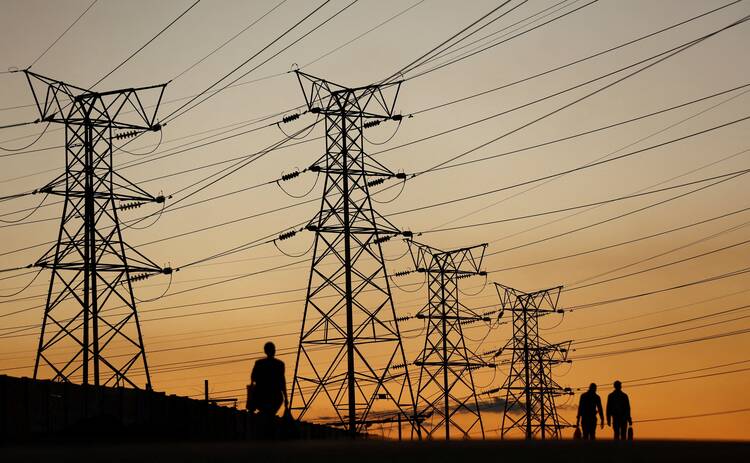
People in Soweto, South Africa, walk past electricity pylons July 3, 2022, during frequent power outages because of aging coal-fired plants. (CNS photo/Siphiwe Sibeko, Reuters)
By: Faith Jemosop
South Africans are no strangers to power cuts, rising utility bills, or political excuses but the latest blow to consumers is harder than ever to ignore.
Households across the country are now being told to brace for a monthly electricity cost increase of R1,615 (about $88). For many, that’s a painful ask in an economy where unemployment remains stubbornly high, and real wages have barely kept up with inflation.
Add in food prices, transport hikes, and fuel volatility, and it’s no wonder households are stretched to the breaking point.
But the timing of this hike is what really stings.
Just as consumers were digesting this new electricity blow, allegations of price manipulation emerged in South Africa’s financial sector prompting the Johannesburg Stock Exchange (JSE) to go on the defensive.
This isn’t just a coincidence. It paints a bigger picture: a nation struggling to balance basic governance with market credibility.
Let’s break it down.
The South African rand weakened sharply on Monday. By mid-morning, it had dropped to R18.30 to the dollar (about $1), down 0.5% from the previous close. One of the main reasons? A stronger dollar globally driven by a U.S.-China deal to ease tariffs and a resulting slump in gold prices.
Now, none of these international factors are in South Africa’s control. But the JSE’s need to respond to price manipulation claims adds an entirely local problem to the mix.
Investors hate uncertainty, and nothing spooks markets faster than the hint of unfair trading. A weaker rand, jittery investors, and local economic anxiety are a cocktail South Africa cannot afford.
Meanwhile, the gold price long considered a hedge in times of uncertainty plunged 3%, as global investors moved their money elsewhere. That movement sent ripple effects through emerging markets, and South Africa got caught in the tide.
But what does all this mean for the average South African?
More expensive imports. Less buying power. And energy costs that are rising, again.
This week’s local focus is on unemployment data and mining production figures. Oxford Economics, in its latest forecast, expects both to disappoint.
It has downgraded GDP growth for the year to just 1%. That’s well below what’s needed to stimulate job creation or attract foreign investment.
Let’s pause on that.
1% growth.
In a country with nearly 33% unemployment. In a country trying to fix its power grid, stabilize the rand, and fight inflation. That’s not growth, it’s stagnation.
And yet, consumers are being asked to shoulder more and more of the burden.
Read Also:
Red Rocket Powers Up South Africa’s Wind Energy Future with Two New Wind Farms
So where’s the accountability?
Who is advocating for South Africans as utilities hike prices and market systems show cracks? Why is it that every economic adjustment, every global tremor, and every local scandal seems to hit the average citizen hardest?
South Africa’s economic institutions, from the Reserve Bank to the JSE to Eskom are meant to provide stability and trust. But trust can’t exist in a vacuum. It’s built on transparency, fairness, and a willingness to act in the public’s interest.
Instead, the perception is growing that the system protects the powerful and bills the powerless.
This isn’t sustainable.
If the JSE wants to restore confidence, it must investigate and publicly address price manipulation allegations without delay. If Eskom wants to justify another increase, it must show South Africans where every cent is going and how it plans to stop the cycle of endless tariffs without delivery.
And if government leaders truly care about inclusive growth, they must stop treating economic hardship like a statistical inconvenience.
The rand will rise and fall. Global deals will come and go. But until domestic leadership prioritizes integrity and equity, the real cost will be paid by the people.