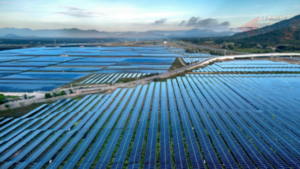
Solar power was the strongest-performing technology in Europe’s electricity system in 2025, reaching 12.5 per cent of the EU power mix, its highest share on record, according to new analysis from Eurelectric.
Total solar generation exceeded 340 terawatt-hours (TWh) during the year, marking a decisive shift in Europe’s supply profile.
Eurelectric described 2025 as a turning point for the power sector, as rapid solar growth reduced reliance on fossil fuels and helped contain emissions at a time of uneven performance across other renewable sources.
Despite this progress, emissions from the EU’s power sector still stood at roughly 45 per cent of 1990 levels, pointing to continued but slowing decarbonisation momentum.
Eurelectric noted that progress toward the bloc’s 50 per cent renewable electricity threshold has decelerated, reflecting structural challenges in aligning capacity growth with demand recovery and market stability.
Solar output increased by 60 TWh year-on-year, an amount roughly equivalent to Portugal’s annual electricity demand. This increase compensated for a 13 per cent drop in hydroelectric generation and a 4 per cent decline in wind output, both linked to unfavourable weather conditions during the year.
Nuclear generation remained largely unchanged, accounting for around 24 per cent of Europe’s electricity supply, maintaining its role as a stable baseload contributor amid variability in renewable output.
Wholesale electricity prices averaged €88 per megawatt-hour (MWh) in 2025. This level was slightly higher than in 2024 but remained well below the peaks seen in 2023.
Price movements were uneven across the year. Higher prices dominated the first half, driven by weaker wind and hydro generation. In the second half, prices eased as strong solar output combined with lower gas prices.
Read Also: Madagascar’s Afripower Begins Utility‑Scale Solar at Mandroseza as Fossil Fuel Costs Bite
Volatility remained pronounced. Power prices exceeded €150 per MWh for 9.3 per cent of hours, while negative prices were recorded during 3.3 per cent of hours, highlighting the growing mismatch between generation profiles and demand patterns.
Eurelectric warned that demand weakness could become a limiting factor for future investment, even as renewables continue to reduce exposure to fossil fuel price shocks.
“Renewables are reducing Europe’s exposure to fossil fuel prices, but weak electricity demand risks slowing investments,” said Kristian Ruby, secretary general of Eurelectric. “Stimulating demand is key to stabilising markets, supporting industry and keeping decarbonisation on track.”
Europe’s 2025 power data underscores a clear hierarchy within the energy transition:
- Solar is scaling faster than any other source
- Weather-dependent generation increases volatility rather than smoothing it
- Market design and demand growth now matter as much as capacity additions
By Thuita Gatero, Managing Editor, Africa Digest News. He specializes in conversations around data centers, AI, cloud infrastructure, and energy.